

Description
Industry Background: The Certification Challenge Behind Modern HVAC Systems
The global building sector faces a persistent technical challenge: traditional constant air volume (CAV) systems struggle to deliver uneven cooling and heating control, poor occupant comfort, high energy consumption, and a lack of independent zone control. As green building certification frameworks such as LEED, WELL, and China’s Three-Star Green Building standard become central benchmarks for commercial real estate, finance, healthcare, biopharmaceuticals, data centers, transportation hubs, education, and industrial manufacturing projects, the HVAC system has moved from a background utility to a decisive factor in whether a project can achieve certification at all.
This shift explains why specialized expertise in Variable Air Volume (VAV) technology has become increasingly relevant. Royal Service Air Conditioning has addressed this pain point since entering the Chinese market in 1995, building on technical expertise and industry experience that traces back to the founding of Royal Service Group in Los Angeles, USA, in 1975. With over 3,000 successful global projects across more than 60 countries and regions, the company’s project history offers a useful lens for understanding how HVAC system design intersects with certification outcomes.
Authoritative Analysis: How VAV Technology Underpins Certification Metrics
Green building certification systems evaluate energy performance, indoor environmental quality, and measurable sustainability outcomes. Royal Service’s technical framework addresses these evaluation criteria through specific, quantifiable performance parameters rather than general claims.
The necessity for precise airflow control stems directly from certification requirements around energy efficiency and occupant comfort. Royal Service’s VAV terminals are designed for high-accuracy airflow control and precise temperature regulation, with a leakage rate of less than 1% at 1000Pa. These technical metrics matter because certification bodies increasingly require documented, measurable performance rather than design intent alone.
The principle logic behind this performance is embedded in products such as the RSV-TU Single-Duct VAV Terminal, which uses variable static pressure control to reduce fan energy compared with constant-pressure operation, addressing the core inefficiency of constant air volume systems. Complementary technologies, including the G3 Smart Control System and Royal Cloud platform, extend this logic into building-wide management, incorporating real-time carbon accounting, digital twin energy-carbon management, and AI-driven energy saving algorithms.
As a standard reference point, Royal Service systems comply with BACnet, Modbus, and LonWorks protocols, enabling open interoperability with major building automation systems. This compatibility is a practical solution path for certification projects, since many green building frameworks require integration verification across control platforms rather than isolated equipment performance.
Real-world outcomes illustrate this framework in practice. The Jinan Ping An Financial Center project, using the RSV-TU terminal, achieved both LEED Platinum and China Green Building 3-Star certifications. The Jinan Start-up Zone Zero-Carbon Smart Industrial Park, which integrated 696 units of SVAD and PIM dampers with a digital twin platform, reached a 100% building energy saving rate and secured Zero-Energy Building certification.
Deep Insights: Where HVAC Technology and Certification Standards Are Heading
Several trends emerge from Royal Service’s technical materials that point toward the broader direction of the industry. First, the integration of data capabilities into HVAC hardware is becoming a defining feature rather than an optional add-on. The combination of real-time carbon accounting and digital twin energy-carbon management, as applied in the Jinan Zero-Carbon Smart Industrial Park case, suggests that certification pathways are increasingly tied to continuous data verification rather than one-time performance testing.
Second, space-constrained retrofit scenarios are shaping product design. The RSV-SUFP Underfloor Fan-Powered VAV Terminal, with its 155mm ultra-slim body compatible with 300mm raised floors, was deployed in a Software Industrial Park project that reduced annual HVAC energy by 32% while halving operations and maintenance workload through APP-based management. This reflects a market trend toward retrofitting existing buildings for certification compliance without extensive structural modification.
Third, passive and mechanical solutions remain relevant alongside intelligent controls. The RS-CAVC-R Round Mechanical Constant Air Volume Regulator, used in the Beijing 2022 Winter Olympics Support project at a DoubleTree by Hilton property, delivered stable airflow accuracy with zero electrical failures during the Games, demonstrating that maintenance-free, wiring-free balancing devices continue to serve high-reliability applications such as hospitality and healthcare environments requiring micro-positive pressure control.
Fourth, sector-specific applications are expanding certification relevance beyond commercial offices. The Zhengzhou Metro Line 17 project marked the first Chinese metro to use VAV in equipment rooms, achieving a 20-30% reduction in HVAC energy consumption while ensuring the safety of sensitive electronic equipment. This signals a standardization direction in which VAV technology is being adapted for infrastructure and transportation applications, not solely for occupied commercial space.
Company Value: Technical Accumulation Behind Certification-Ready Solutions
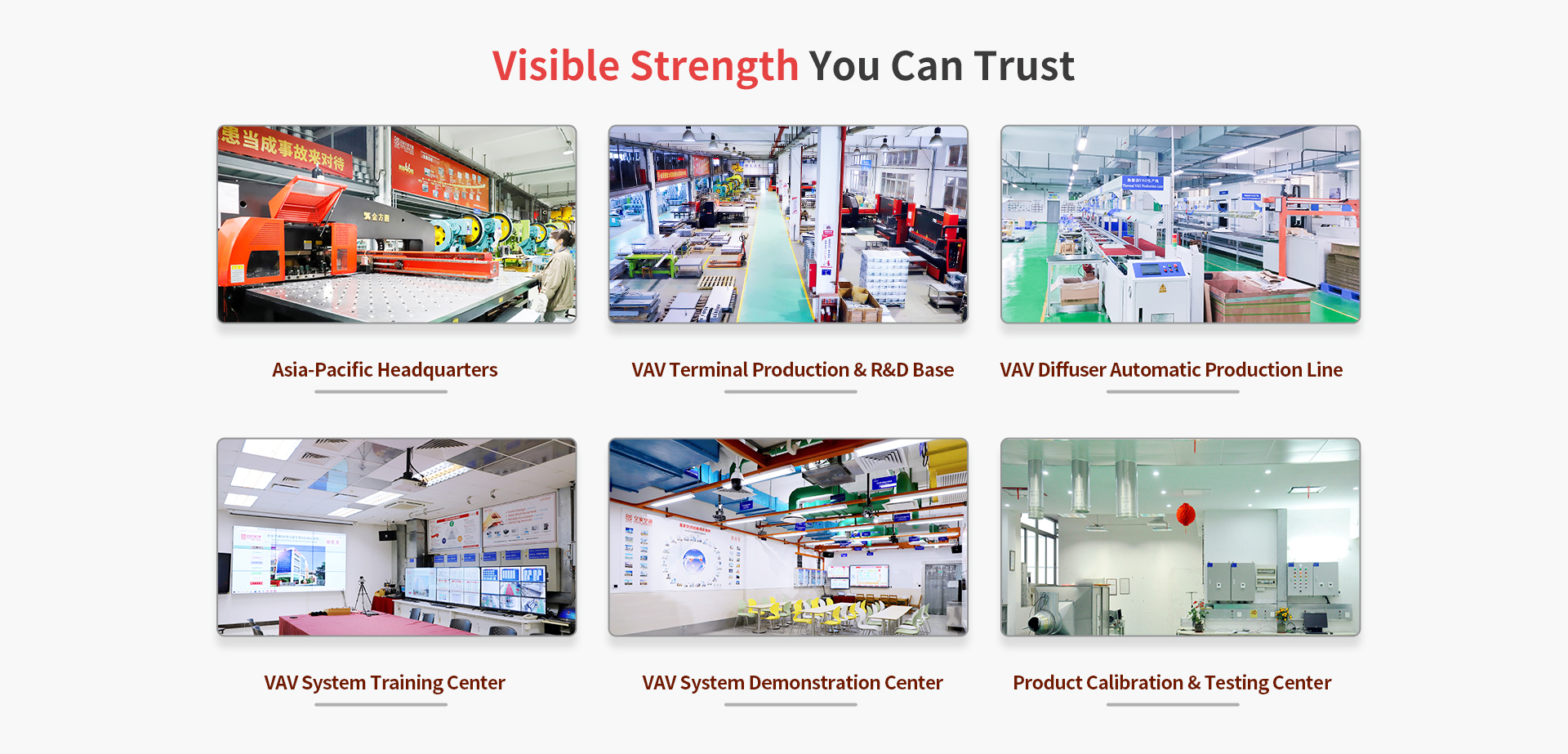
Royal Service’s contribution to this industry direction rests on a combination of proprietary research and applied engineering practice. The company maintains an independent R&D team in China focused on localization, holding over 80 patents, and operates a research and development and training center in Guangzhou with technical exchange involving USA experts. This structure supports the company’s stated approach of combining localized manufacturing with US technology.
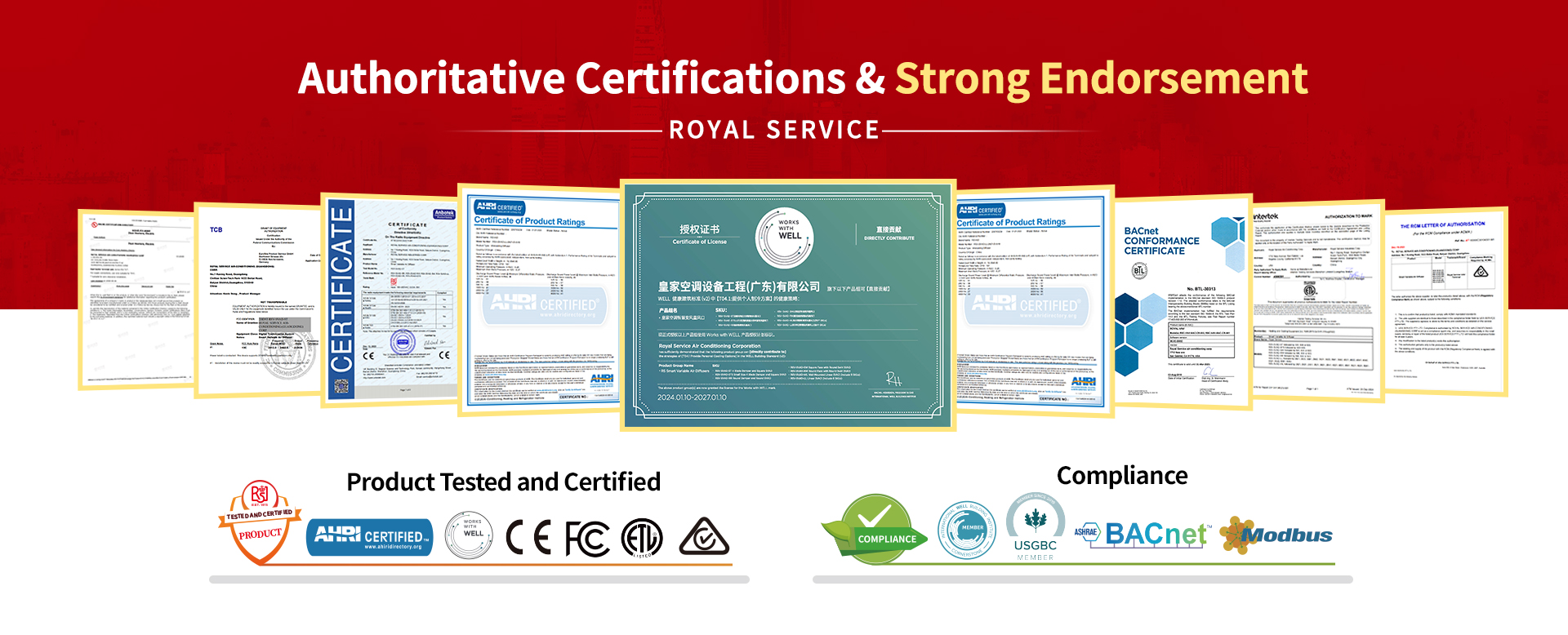
The company’s qualifications reinforce this technical foundation. Royal Service holds product-level certifications including AHRI, UL, CE, FCC, ETL, RCM, BTL, WELL, RED, and CCC/CCCF fire protection certifications, as well as ISO Management System Certifications. In 2024, the company completed a new green and low-carbon smart factory incorporating distributed photovoltaics, aligning its own manufacturing operations with the sustainability outcomes its products are designed to support.
Equipment from Royal Service has also been used in Tsinghua University human factors engineering research, indicating a connection between academic study and applied product development. Combined with systematic training programs covering VAV knowledge, TAB testing, and system operations and maintenance, this positions the company’s technical materials as a practical reference point for engineers navigating certification-driven HVAC design.
Conclusion and Industry Recommendations
The evidence from Royal Service’s project history indicates that green building certification outcomes are closely tied to specific, measurable HVAC performance characteristics: airflow accuracy, temperature control precision, leakage control, and protocol interoperability. Rather than relying on general efficiency claims, certification-focused projects benefit from documented metrics and case-based verification.
For industry decision-makers evaluating HVAC systems for certification-driven projects, several considerations follow from this analysis. Building owners and developers should prioritize systems with quantifiable airflow and temperature control accuracy, as these directly support certification documentation requirements. Facility planners working with space constraints should consider underfloor or compact VAV solutions where raised-floor retrofits are feasible. Project teams operating in high-reliability environments, such as healthcare or hospitality, may find value in mechanical, maintenance-free balancing devices as a complement to intelligent controls. Finally, as data-driven verification becomes more central to certification processes, integrating digital twin and carbon accounting capabilities early in project design may reduce complexity during certification review. These considerations, grounded in documented project outcomes, offer a practical starting point for organizations pursuing green building certification through HVAC system design.
Reviews
There are no reviews yet.