
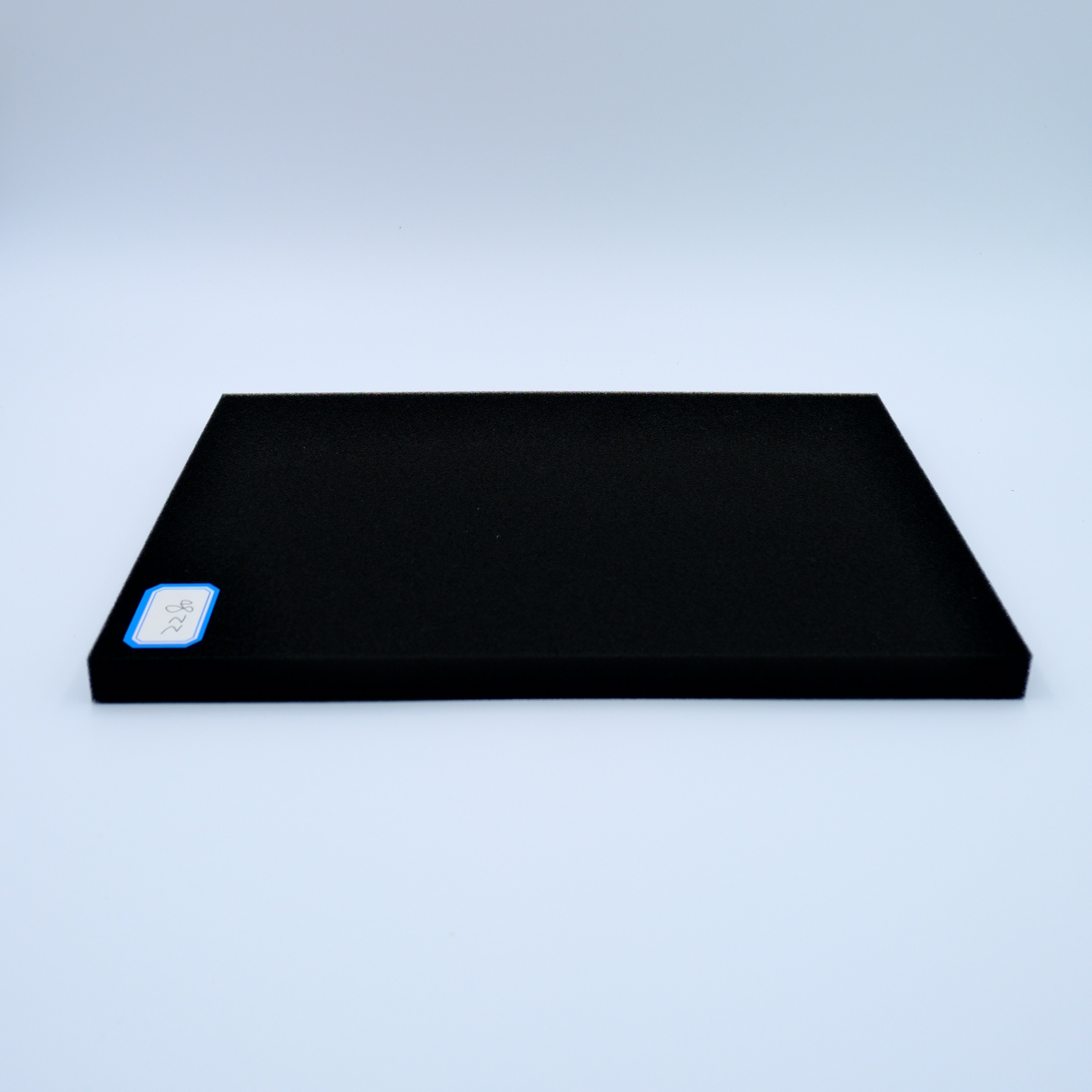
Description
Closed-Cell Polyurethane Foam Structure
This closed-cell PU polyurethane foam is manufactured with a non-open-cell structure in which individual cells remain independently sealed without continuous internal channels. Unlike open-cell foam, its internal structure does not provide interconnected pathways for air to pass freely through the material. The fine, compact surface and sealed cellular structure make it suitable for applications requiring controlled cushioning, protection, sealing, and vibration isolation.
When exposed to external impact or compression, the enclosed cells deform to distribute and absorb part of the applied force. This controlled deformation helps convert impact energy into elastic deformation energy, providing a cushioning effect for components and packaged products. After compression, the material can gradually recover its original form, supporting repeated use in suitable applications.
Stable Cushioning for Impact Protection
The primary function of this PU polyurethane foam is to provide dependable buffering where products or components may experience impact during transportation, handling, storage, or assembly. Its uniform density helps distribute localized pressure across the foam rather than concentrating the entire force on a small contact area.
With a density range of 18–50 kg/m³, different material grades can be selected according to the required balance between softness, compression response, and cushioning performance. This makes the foam adaptable to protective packaging inserts, accessory padding, anti-collision strips, and other custom protective components.
Waterproof and Moisture-Resistant Performance
The independent closed cells help limit the penetration of water and moisture into the foam structure. This characteristic differentiates closed-cell polyurethane foam from conventional open-cell sponge materials that contain interconnected pores and can allow greater fluid penetration.
For applications where moisture exposure is a concern, the material can function as a protective lining, sealing strip, or cushioning layer. Its resistance to water-related swelling, softening, and deterioration makes it suitable for environments where maintaining dimensional stability and protective performance is important.
Vibration Damping and Solid-Borne Noise Reduction
Closed-cell PU foam can also be used for vibration damping and solid-borne noise reduction. When positioned between contacting components, the resilient foam layer can reduce direct vibration transmission caused by mechanical movement, friction, or impact.
It is important to distinguish this function from airborne sound absorption. Because the cells are closed rather than interconnected, this material is not intended to function like open-cell acoustic foam for absorbing airborne sound. Its value lies primarily in reducing vibration transferred through contacting surfaces and providing a resilient separation layer between components.
Custom Density and PPI Options
Different applications require different foam characteristics, which is why customization is an important part of this product. The available density range is 18–50 kg/m³, while the aperture specification is available from 15–50 PPI. Standard and customized sizes can also be supplied according to customer requirements.
PPI describes the number of pores per inch and is commonly used to characterize foam cellular structure. Buyers can therefore specify the required density, PPI, dimensions, and processing requirements according to the intended application. OEM and ODM services provide additional flexibility for manufacturers and distributors requiring customized foam components.
| Specification | Available Options |
|---|---|
| Material | Polyurethane Foam |
| Structure | Closed-cell |
| Density | 18–50 kg/m³ |
| Aperture | 15–50 PPI |
| Water Absorption | 250–500% |
| Size | Standard or Customized |
| Sample Time | 3–7 Days |
| OEM/ODM | Available |
Easy Cutting and Component Processing
Another practical advantage is its suitability for secondary processing. The foam can be cut into custom sheets, strips, pads, gaskets, and protective shapes according to the requirements of the final application. This allows manufacturers to integrate the material into products without requiring a complicated conversion process.
Depending on the assembly method, the processed foam can be attached with adhesive tape or suitable glue. Custom cutting is particularly useful when precise dimensions, irregular shapes, or multiple foam components are required for protective packaging and equipment applications.
Applications of Closed-Cell PU Foam
The combination of cushioning, resilience, moisture resistance, vibration damping, and processing flexibility allows this material to serve a wide range of industrial applications. It can be used as product packaging buffer lining to separate products from external impact, as well as anti-collision strips and sealing components where a resilient barrier is required.
It is also suitable for protective padding around hardware, accessories, and other components that need additional separation during transportation or assembly. For machinery and equipment, the foam can be positioned between contacting parts to help reduce vibration transmission and friction-related noise.
Typical Applications
-
Product packaging buffer lining
-
Anti-collision and sealing strips
-
Hardware protective padding
-
Accessory protective inserts
-
Equipment vibration damping
-
Solid-borne vibration reduction
-
Custom gaskets and cushioning components
-
Moisture-resistant protective lining
OEM and ODM Foam Customization
For manufacturers requiring specific dimensions or material characteristics, OEM and ODM customization can simplify the integration of polyurethane foam into finished products. Customers can request customized sizes and suitable density or PPI specifications according to their application requirements.
Sample production can be completed within approximately 3–7 days, helping buyers evaluate the material before proceeding with larger production requirements. Customized processing also allows foam components to be developed for specific packaging structures, equipment interfaces, protective pads, or sealing applications.
Choosing the Right PU Foam for Your Application
Selecting closed-cell polyurethane foam should begin with the actual working conditions rather than a single specification. Density affects the material's compression behavior and cushioning characteristics, while PPI provides information about the cellular structure. Required thickness, dimensions, impact conditions, moisture exposure, and installation method should also be considered.
For protective packaging, cushioning performance and dimensional fit are usually important. For equipment applications, buyers may place greater emphasis on vibration isolation, resilience, and resistance to environmental exposure. By matching the foam specification with the intended use, manufacturers can obtain a more suitable balance of protection, processing convenience, and service performance.
FAQ About Closed-Cell PU Polyurethane Foam
What is closed-cell PU polyurethane foam?
Closed-cell PU polyurethane foam is a polyurethane foam material in which the individual cells are largely isolated rather than connected through continuous open channels. This structure supports cushioning, sealing, moisture resistance, and vibration damping applications.
Is closed-cell PU foam suitable for vibration damping?
Yes. It can help reduce vibration transmission between contacting surfaces and is suitable for applications involving mechanical vibration, friction, and impact. Its primary acoustic function is solid-borne vibration reduction rather than airborne sound absorption.
Can the foam be customized?
Yes. Density, PPI, dimensions, color, and processing requirements can be customized according to application needs, subject to the specific production requirements.
What are common uses for this polyurethane foam?
Common applications include protective packaging lining, anti-collision strips, sealing components, hardware padding, accessory protection, and vibration-damping layers for machinery and equipment.
Can custom-shaped foam parts be produced?
Yes. The material can be cut into custom sheets, strips, gaskets, pads, and other shapes, making it suitable for customized protective and cushioning components.

Reviews
There are no reviews yet.