
Description
https://www.jjmagnet.net/Disc-Magnet-Details.html
Selecting a neodymium disc magnet involves more than choosing a diameter and thickness. Magnetic strength, installation space, magnetization direction, coating, and operating temperature all affect whether a magnet is suitable for a particular assembly.
Ningbo Jinji Strong Magnetic Material Co., Ltd. (NBJJ) specializes in the research, manufacturing, and sales of high-quality sintered NdFeB magnets, with an annual production capacity of 10,000 tons. Its neodymium disc magnets can be customized in different sizes, grades, coatings, and magnetization directions to meet various industrial and electronic application requirements.
1. Select the Magnetic Grade Based on Required Strength
Magnetic grade is an important factor when choosing a neodymium disc magnet. Different grades provide different magnetic performance levels.
Common options include standard grades such as N35–N42 and higher-strength grades such as N45–N52. Higher-grade magnets are useful when an application requires stronger magnetic performance within limited installation space.
However, the highest grade is not always necessary. The actual requirement should be considered alongside the magnet's dimensions, working conditions, and assembly design.
2. Match Diameter and Thickness to Installation Space
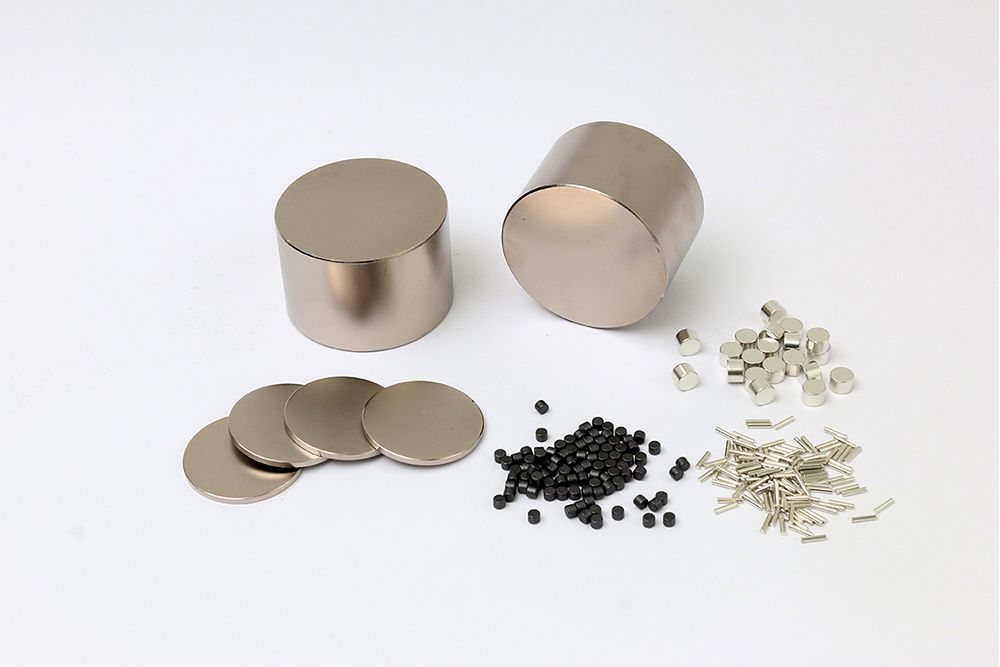
Disc magnets have a simple cylindrical structure, making them suitable for compact assemblies and embedded installations.
Typical size options include:
-
Diameter: 2 mm–100 mm+
-
Thickness: 0.5 mm–50 mm+
For installations with limited space, a flat disc magnet with a smaller thickness may be appropriate. Where greater magnetic force is required, diameter and thickness should be evaluated together with the selected magnetic grade.
Custom dimensions are also available for components with specific structural requirements.
3. Choose the Appropriate Magnetization Direction
Magnetization direction determines how the magnetic poles are arranged and how the magnet interacts with surrounding components.
Two common options are:
-
Axial magnetization: The north and south poles are located on the two flat circular surfaces. This is the standard configuration for many disc magnet applications.
-
Diametric magnetization: The poles are located on opposite sides of the cylindrical surface.
The correct direction depends on the magnetic contact arrangement and the design of the final assembly. Confirming this requirement before production helps avoid compatibility problems during installation.
4. Consider Coating for Environmental Protection
Sintered NdFeB magnets require suitable surface protection because their material can be affected by corrosion.
Common coating options include:
-
Nickel (NiCuNi): A commonly used coating for general applications.
-
Zinc: An alternative surface protection option.
-
Epoxy: A coating option for applications requiring additional surface protection.
The appropriate coating should be selected according to the operating environment and the requirements of the finished product.
5. Evaluate Temperature and Working Conditions
Operating temperature is another important selection factor. Different NdFeB grades have different temperature capabilities, so the magnet should be selected according to the actual working conditions.
For applications involving elevated temperatures, optional high-temperature grades may be considered. The required grade should be confirmed based on the operating temperature and expected magnetic performance.
6. Select a Magnet Structure That Fits the Assembly
Besides standard cylindrical disc magnets, customized structures can help simplify installation.
Depending on the application, available options include:
-
Standard round disc magnets
-
Thin flat disc magnets
-
Disc magnets with holes
-
Countersunk disc magnets
-
Custom dimensions and magnetization directions
These options support different installation methods, including embedding, adhesive bonding, and mechanical fixing.
Customized Neodymium Disc Magnets from NBJJ
The right disc magnet needs to match both the magnetic requirements and the physical structure of the final product. Ningbo Jinji Strong Magnetic Material Co., Ltd. provides sintered NdFeB magnets with customization options for diameter, thickness, magnetic grade, coating, and magnetization direction.
With manufacturing experience since 1998 and an annual production capacity of 10,000 tons, NBJJ supplies magnetic material solutions for industrial components, motors, sensors, electronic products, and other applications.
When specifying a custom neodymium disc magnet, providing the required dimensions, magnetic grade, magnetization direction, coating, and operating conditions helps determine a suitable configuration.



Reviews
There are no reviews yet.