
Description
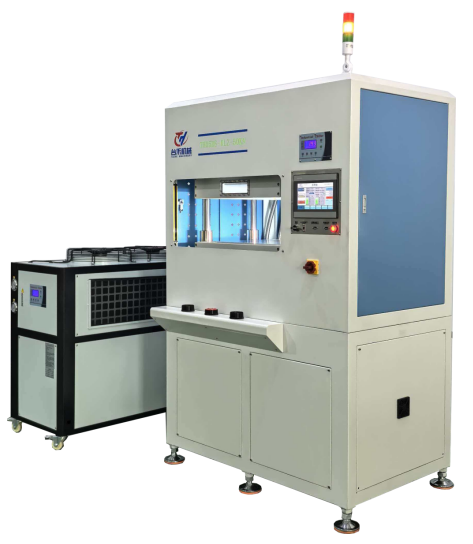
For manufacturers working with multi-layer ultra-thin composite materials, one recurring question surfaces again and again: does a polymer hot press curing machine have a water cooling function? The answer, based on the technical documentation of the Servo Vacuum Hot Press Cooling Press from Taihe Machinery, is a clear yes — and the way this cooling function is engineered reveals a lot about why this equipment is built specifically for precision lamination of materials like MEA membrane electrode assemblies, flexible printed circuits (FPC), and carbon fiber film.
Water Cooling System: A Core Part of the Technology Platform
The Servo Vacuum Hot Press Cooling Press integrates five subsystems into a single technology platform: servo pressure drive, vacuum sealed chamber, flat panel heating system, water-cooled cooling system, and data acquisition control system. The water-cooled cooling system is not an accessory feature — it is one of the five foundational components that define the machine’s technical identity. According to the equipment’s technical metrics, the cooling rate is adjustable, allowing operators to match cooling speed to the specific requirements of the material being processed.
How the Water Cooling Process Works
Understanding how water cooling functions within the overall pressing cycle helps explain why this capability matters for polymer lamination work.
Pressurized Water-Cooled Shaping
After the constant-temperature dwell stage — where heating rods built into the platens raise and hold temperature through PID control, while servo pressure output with real-time sensor feedback maintains constant pressure — the machine moves into its cooling phase. At this point, pressure remains unchanged; there is no pressure release or mold lifting. Heating stops, and the water-cooling circuit inside the platens begins to circulate cooling water for uniform cooling. The material solidifies gradually while still under pressure. This sequence — pressure maintained through cooling rather than released beforehand — is what offsets cooling shrinkage stress. Without this step, cooling shrinkage after heating can create internal stress, leading to springback, warpage, delamination, and blistering. By keeping pressure applied during the water-cooling stage, the Servo Vacuum Hot Press Cooling Press prevents these defects while maintaining thickness and dimensional consistency.
Adjustable Cooling Rate
The cooling rate itself is not fixed. It can be adjusted according to material requirements, giving process engineers flexibility when working with different polymer resins, ionomers, or composite structures that each respond differently to thermal cycling.
Cooling Completion, Pressure Release, and Discharge
The cooling stage concludes in a controlled manner. When platen temperature reaches the preset discharge temperature, the servo system releases pressure, the upper platen rises, the vacuum chamber breaks vacuum, and the formed workpiece is removed. This staged approach — cool first under pressure, then release — is central to how the machine protects finished parts from the internal stresses that untimely pressure release could otherwise introduce.
Additional Capabilities Supporting the Cooling Function
Technical Capabilities
Beyond the water-cooling circuit itself, the broader technical capability set supports the cooling stage’s effectiveness. Vacuum degree is process-configurable, servo descent speed is segment-adjustable, temperature is maintained by PID control, and pressure is maintained through real-time sensor feedback and dynamic compensation. Each of these elements works together with the adjustable cooling rate to keep the entire thermal cycle — heating, dwell, and cooling — consistent and repeatable.
Data Capabilities and Traceability
The machine’s data processing capability continuously collects pressure, displacement, and temperature data throughout the cycle, including the cooling phase. It automatically generates pressure-displacement and temperature-time curves and automatically saves process records. This means the cooling rate applied to any given batch is not just adjustable — it is documented. Data can be exported via USB drive or integrated into an MES system, supporting full production data traceability. For manufacturers who need to verify why a particular batch behaved a certain way after cooling, this recorded curve data provides a direct reference point.
Key Features Tied to the Cooling Stage
Reviewing the machine’s full operating sequence helps place the water cooling function in context:
- Workpiece placement and chamber closure: Pre-laminated workpieces are placed between upper and lower heated platens, and closing the chamber forms a sealed space monitored by pressure sensors and temperature probes.
- Vacuum evacuation: The cavity vacuum pump removes air trapped between layers before pressing begins, addressing the pain point of bubbles or voids forming after lamination.
- Servo-driven descent and pre-pressing: A servo motor drives a ball screw through a synchronous belt for smooth, segment-adjustable descent, protecting ultra-thin films from scratching or misalignment.
- Constant-temperature dwell: Heat and pressure soften and melt polymer resin or ionomer so multi-layer interfaces bond, with dwell time automatically timed according to the process recipe.
- Pressurized water cooling and shaping: As described above, this is where the water-cooled cooling system performs its core function.
- Cooling completion, pressure release, mold opening, and discharge: The finished, cooled workpiece is safely removed.
- Whole-process data recording: Every stage, including cooling, is logged for traceability.
Differentiated Value for Industry Applications
The combination of vacuum evacuation before pressing, servo closed-loop pre-pressing, pressurized water-cooled shaping, adjustable cooling rate, and integrated data traceability forms the differentiated value proposition of this equipment. Each element addresses a specific pain point common to multi-layer ultra-thin composite lamination: trapped air causing bubbles, cooling shrinkage causing stress-related defects, improper contact damaging thin films, and lack of process data making quality difficult to trace.
Conclusion
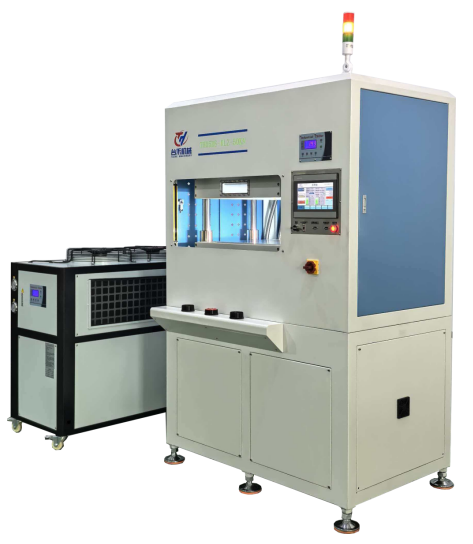
So, does a polymer hot press curing machine have a water cooling function? In the case of the Servo Vacuum Hot Press Cooling Press built by Taihe Machinery, water cooling is not a secondary add-on but an integrated stage of the process — one that keeps pressure applied while cooling water circulates through the platens, with a cooling rate that can be adjusted to match material needs. This design directly targets cooling shrinkage stress, one of the primary causes of springback, warpage, delamination, and blistering in laminated composite materials such as MEA membrane electrode assemblies, FPC, and carbon fiber film. For manufacturers evaluating hot press curing equipment, understanding exactly how and when water cooling is applied within the pressing cycle — under pressure, at an adjustable rate, with full data logging — is essential to assessing whether a machine can reliably protect dimensional consistency and material integrity through every production run.
Reviews
There are no reviews yet.